
This Changes Everything

Love is needed right now, don’t you think? I don’t know about you, but I feel more tired than usual. More impatient. Quicker to get annoyed at my kids. It’s not just Christmas pressure. It’s the weight of a long year and the added heaviness of recent events here on home soil.
Maybe you feel it too. When we’re tired, angry, or afraid, love can feel like the least practical option. And yet, Advent insists on it.
Not love as a feeling. Not love as politeness or positivity. But love as presence. Love that stays. Love that moves toward rather than away.
By the end of the year, our capacity feels low. It can feel easier to protect ourselves, to disengage, to try to keep life small and manageable. Advent doesn’t deny that reality. It meets us there. And then it gently, stubbornly, points us toward love again.
This is the tension Advent helps us name. The world is still groaning, and yet the King has come. The light has dawned, but the darkness has not disappeared. We are not living after everything has been fixed. We are living in the middle.
And in the middle, God does not withdraw. He draws near.
In Jesus, love takes on flesh. God does not send an idea or a solution. He comes Himself. Vulnerable. Interruptible. Close enough to be rejected. This is not safe love. It is powerful love. Love that chooses presence over control, relationship over distance.
This is where Advent begins. Not with what we can offer, but with what we receive. We are loved first. Loved in our tiredness. Loved in our confusion. Loved in ways that slowly, deeply reshape us.
Because love, when it is real, does not stop at comfort. It moves us outward. It invites us to join God in what He is doing in the world. To keep showing up. To keep seeing people. To keep choosing connection when it would be easier to turn away.
Love is not weakness. Right now, love is one of the most courageous things we can practise.
READ
-
This is how the birth of Jesus the Messiah came about: His mother Mary was pledged to be married to Joseph, but before they came together, she was found to be pregnant through the Holy Spirit. 19 Because Joseph her husband was faithful to the law, and yet did not want to expose her to public disgrace, he had in mind to divorce her quietly.
20 But after he had considered this, an angel of the Lord appeared to him in a dream and said, “Joseph son of David, do not be afraid to take Mary home as your wife, because what is conceived in her is from the Holy Spirit. 21 She will give birth to a son, and you are to give him the name Jesus, because he will save his people from their sins.”
22 All this took place to fulfill what the Lord had said through the prophet: 23 “The virgin will conceive and give birth to a son, and they will call him Immanuel” (which means “God with us”).
24 When Joseph woke up, he did what the angel of the Lord had commanded him and took Mary home as his wife. 25 But he did not consummate their marriage until she gave birth to a son. And he gave him the name Jesus.
-
This is how God showed his love among us: He sent his one and only Son into the world that we might live through him. 10 This is love: not that we loved God, but that he loved us and sent his Son as an atoning sacrifice for our sins. 11 Dear friends, since God so loved us, we also ought to love one another. 12 No one has ever seen God; but if we love one another, God lives in us and his love is made complete in us.
GO DEEPER
Scripture is clear that love is not a side theme of the Christian life. It is the centre.
“When God’s love was revealed among us,” John writes, “he sent his one and only Son into the world so that we might live through him” (1 John 4:9). Love is not merely something God does. Love is how God comes. It is the means by which the Kingdom arrives.
Jesus’ life makes this unmistakable. From the manger to the cross, God’s power is revealed not through domination, but through self-giving presence. This is the great reversal of the Kingdom. The most transformative force in the world is not control, violence, or certainty. It is love that stays.
This is why love is so demanding. Real love costs something. It requires attention. Patience. The willingness to be affected by the lives of others. Love refuses to reduce people to categories or positions. It insists on relationship.
In the language of the Kingdom, love is not passive. It is active participation in God’s renewal of all things. Jesus announces this in His ministry when He declares good news for the poor, freedom for the oppressed, and healing for the broken-hearted. Love is not abstract compassion. It takes shape in concrete acts of faithfulness and justice.
God’s new world has begun to break in, but it hasn’t finished its work yet. Love is how we learn to live faithfully in that tension. It is how the future of God’s world presses into the present.
Importantly, this love is not something we generate through effort alone. It flows from encounter. “We love because he first loved us.” The Spirit forms in us what we could not sustain on our own. Love becomes a practice we grow into, shaped by grace.
In a world tempted by cynicism or self-protection, choosing love is an act of resistance. It is a declaration that God is still at work. That the Kingdom is still coming. And that we are invited to participate in it.
This is how we join God in what He is doing. Not by escaping the world, but by loving it. Not perfectly, but faithfully.
ADVENT CANDLE
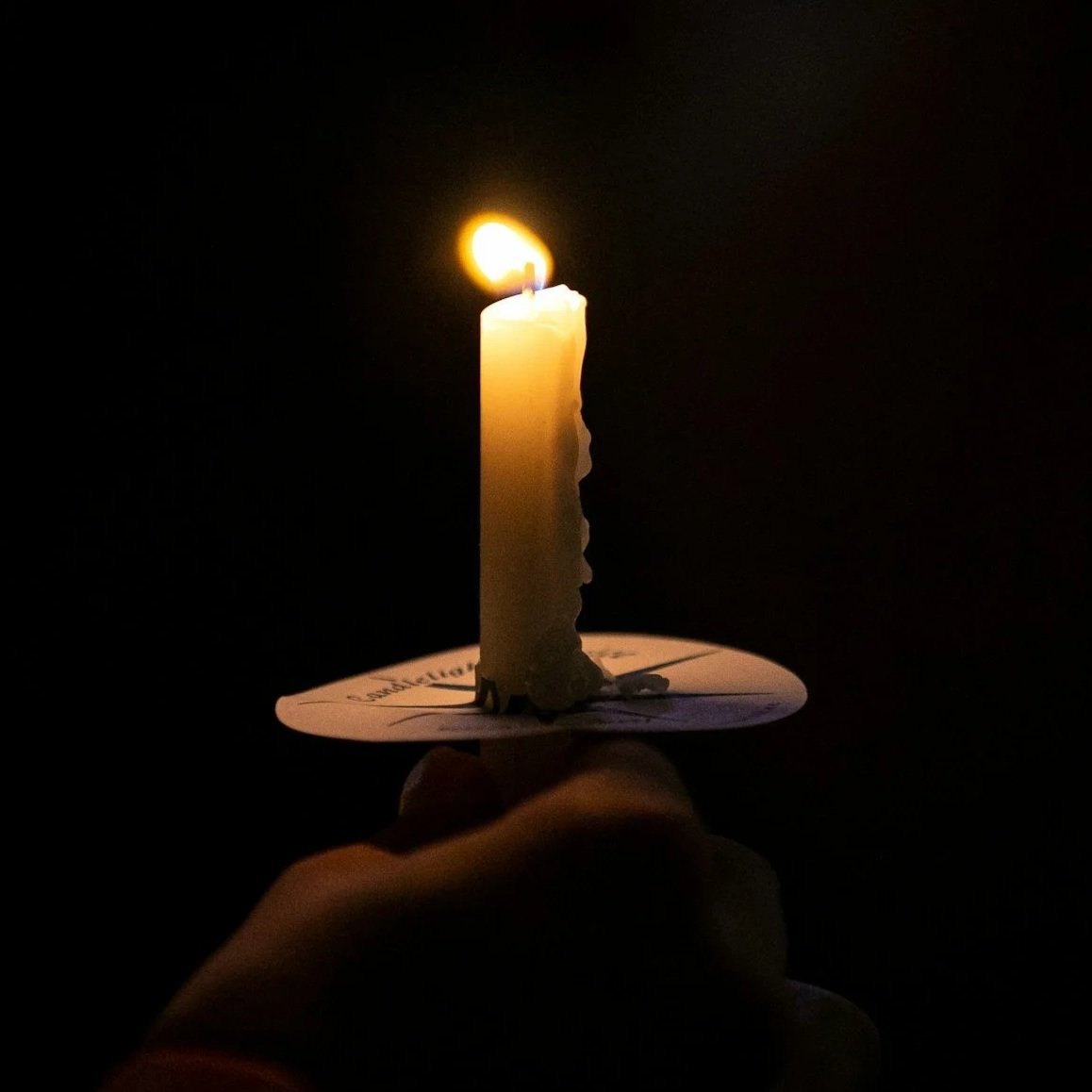
As we light this candle, we remember your love.
A love that came close in Jesus—
and stays close, even now.
Your love has changed everything.
Keep changing us.
Help us live in your love,
and move toward others with that same love.
Amen.